
Description
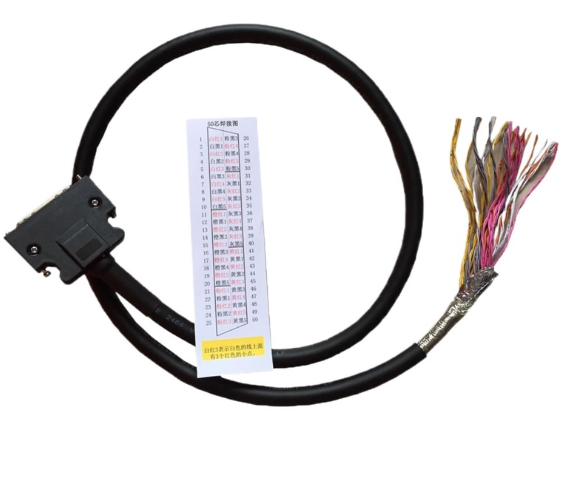
The MR-J3CCN1CBL2M is a Mitsubishi Electric MELSERVO-J3 series CN1 connection cable — a 50-pin SCSI-type pigtail cable (2-meter length) that breaks out the CN1 I/O signal interface of the MR-J3-A servo amplifier to a terminal strip or external controller (PLC, motion controller, CNC). It is the standard harness Mitsubishi ships for wiring the CN1 port on MR-J3-A amplifiers, enabling position/speed/torque mode control via pulse-train + analog input, or CC-Link communication.
- Model breakdown (Mitsubishi MELSERVO-J3 naming):
- MR-J3 = MELSERVO-J3 series servo system
- CN1 = CN1 port — the I/O signal connector on MR-J3-A amplifiers (50-pin SCSI style)
- CBL = CaBLe (pigtail/harness type, not a bare connector)
- 2M = Cable length = 2 meters
- → MR-J3CCN1CBL2M = MELSERVO-J3 CN1 pigtail cable, 2m length, 50-pin SCSI connector, for MR-J3-A servo amplifier
💡 Official Mitsubishi model convention: Mitsubishi’s catalog lists this cable family as MR-J3CCN1CBL-☐M where ☐ = cable length (1m, 3m, 5m) . The MR-J3CCN1CBL2M (2-meter variant) follows the same design — 50-pin connector for direct CN1 port connection on MR-J3 servo amplifiers, suitable for precise I/O signal wiring, operable between 0–55°C (storage: -20 to 75°C) . While Mitsubishi’s published standard lengths are 1m / 3m / 5m , the 2M version is a commonly supplied length in the aftermarket and distributor channels (priced ~¥92 in Asian markets ), fully form-fit-function equivalent to the 1M/3M siblings.
⚠️ CN1 ≠ CN10 — know which port you need! Mitsubishi MR-J3 amplifiers have TWO 50-pin SCSI-style ports:
⚠️ Compatibility is restricted to MR-J3 (and certain MR-JE/J4 small-capacity setups):
What’s on the CN1 port (what this cable carries)
The CN1 50-pin interface on MR-J3-A amplifiers includes:
- Digital inputs (DI): SON (servo on), PC (positive overtravel), NC (negative overtravel), EMG (emergency stop), LSP/LSN (soft limit), INH (torque/pulse inhibit), STEP (jog), etc.
- Digital outputs (DO): RDY (ready), SSP (speed reach), ALM (alarm), BAT (battery low), etc.
- Pulse train inputs: PULS1/PULS2 (differential pulse train for position mode)
- Analog inputs: ANAL1/ANAL2 (analog voltage for speed/torque command)
- Override / reference: REF (reference input)
- Ground / shield: Multiple pins for signal GND and cable shield
The MR-J3CCN1CBL2M breaks these 50 pins out to a pigtail (loose wires or terminal-block-ready ends) so you can wire them to your PLC, motion controller, or terminal strip.
Key Features
- Genuine Mitsubishi MELSERVO-J3 CN1 cable — 50-pin SCSI-type connector (SCSI-50P style) precisely matches the MR-J3-A amplifier’s CN1 port
- 2-meter length — ideal for cabinets where the amplifier is mounted mid-panel and the breakout terminal is within ~1.5–2m; longer runs use 3M/5M variants
- Pigtail configuration — cable terminates in loose wires (or prepared ends) for direct termination to DIN rail terminal blocks, PLC I/O modules, or custom breakout boards
- Industrial-grade construction — operable 0–55°C, storage -20 to 75°C; shielded for EMI/RFI immunity in noisy industrial environments
- Signal integrity — proper shielding prevents communication errors between servo amplifier and controller
- Drop-in replacement — 100% form-fit-function equivalent to Mitsubishi MR-J3CCN1CBL-1M / -3M / -5M ; if your original cable is damaged or too short, this 2M version is a direct swap (just manage the excess length)
- Universal I/O breakout — supports position control (pulse train + DI/DO), speed control (analog + DI/DO), torque control, and CC-Link I/O wiring
Technical Specifications (MR-J3CCN1CBL2M — CN1 Pigtail Cable, 2M)
Parameter | Specification |
|---|---|
Model / Order Code | MR-J3CCN1CBL2M (market variant of MR-J3CCN1CBL-☐M family) |
Brand | Mitsubishi Electric (Japan) |
Series | MELSERVO-J3 |
Cable Type | CN1 pigtail / harness cable (signal breakout) |
Connector (Amplifier End) | 50-pin SCSI-style (SCSI-50P) — mates with MR-J3-A CN1 port |
Connector (Field End) | Pigtail / loose-wire (or terminal-block-ready) |
Cable Length | 2 meters |
Pin Count | 50 pins |
Target Port | CN1 on MR-J3-A servo amplifiers (50-pin SCSI interface) |
Compatible Amplifiers | Mitsubishi MR-J3-A series (100W, 200W, 400W, 750W, 1.5kW) — CN1 I/O port |
Also Referenced For | MR-JE / MR-J3 / MR-J4 small-capacity (100W–750W) — via MR-J3CN1 connector family |
Signal Types Carried | Digital I/O (DI/DO), pulse-train inputs, analog inputs, override, shield/ground |
Operating Temp. | 0 … +55 °C |
Storage Temp. | -20 … +75 °C |
Shielding | Yes — shielded cable for EMI/RFI immunity |
Market Reference Price | ~¥92 (Asia distributor) |
Country of Origin | Japan / Mitsubishi-approved contract manufacturing |
Compliance | CE, UL/cUL (typical for Mitsubishi industrial cables) |
⚠️ Critical compatibility checklist:
Warranty & After-Sales
- Factory new units: 12 months warranty
- Refurbished units: 3-6 months warranty (bench: visual inspection for jacket damage/abrasion, connector pin continuity test (all 50 pins), shielding integrity check, SCSI-50P mating test with MR-J3-A CN1 port dummy, signal integrity verification)
- Technical support for:
- MR-J3-A CN1 pinout verification (we provide the full 50-pin CN1 pin assignment table for MR-J3-A — DI/DO, pulse, analog, ground; matched to your control mode: position / speed / torque / CC-Link)
- Cable length selection (1M / 2M / 3M / 5M — we stock all; 2M is the most popular for standard cabinets; longer runs for large panels)
- MR-J3CN1CBL vs MR-J3CN1 distinction (pre-made cable vs bare connector — if you want to make your own harness, MR-J3CN1 bare connector is available ; if you want plug-and-play, this MR-J3CCN1CBL2M)
- Terminal block pairing (the MR-J2M-CN1TBL junction terminal block is for CN1 pigtail termination — compatible with MR-J3CN1CBL family for clean DIN-rail mounting ; we can bundle)
- Control mode wiring guidance (position mode: pulse train + DI/DO wiring; speed mode: analog + DI/DO; torque mode: analog + ENBL; CC-Link: RD/SD/FG wiring — we provide schematics)
- MR-J3-A sub-series confirmation (MR-J3-A-RJ (100–200W), MR-J3-A (400–750W), MR-J3-A-T (1.5kW) — all share the same CN1 50-pin SCSI interface; MR-J3CCN1CBL2M fits all)
- Cross-series compatibility check (if your amplifier is actually MR-J4-A, MR-JE-A, or MR-J3-B → the MR-J3CN1 connector family is also referenced for MR-JE/J3/J4 small-capacity CN1/CN1A/CN1B ; but the exact cable may differ — send us your amplifier model for verification)
- Replacement for damaged cable (if your existing MR-J3CCN1CBL-☐M is frayed, shorted, or has bent pins → this 2M is a direct replacement; just manage excess length with cable ties)
- Optional: MR-J3CN1 bare connector (if you want to make custom-length harness), MR-J2M-CN1TBL junction terminal block (DIN-rail mount for CN1 pigtail termination), MR-J3ENCBL encoder cable (for motor encoder side), MR-PWS1CBL power cable (for motor power side), MR-J3BUS SSCNET fiber (for MR-J3-B), CNC/PLC I/O terminal modules
Delivery Time
- Standard delivery: 3-5 working days (stock NOS — MR-J3CCN1CBL family is widely available through Mitsubishi distribution)
- Express shipping available upon request
- Note: Genuine Mitsubishi Electric branded stock lead time ~2-4 weeks from Japan; we maintain NOS inventory for urgent replacement
Why Choose Our Store
- Genuine Mitsubishi Electric MR-J3CCN1CBL2M — not gray-market (50-pin SCSI connector molding, shield termination, and wire gauge are critical for signal integrity; clones suffer EMI-induced communication errors and alarm codes )
- Global supply network with competitive pricing on full Mitsubishi MELSERVO-J3 cable family (MR-J3CCN1CBL-1M/2M/3M/5M, MR-J3CN1 bare connector, MR-J3ENCBL encoder cables, MR-PWS1CBL power cables, MR-J3BUS SSCNET fibers)
- Expertise in Mitsubishi servo wiring (MR-J3-A CN1 50-pin pinout, MR-J3CN1CBL vs MR-J3CN1 distinction, 2M length suitability, position/speed/torque/CC-Link control mode wiring, MR-J2M-CN1TBL terminal block pairing, MR-J3-A sub-series compatibility, cross-series MR-JE/J4 verification, replacement for damaged CN1 cable)
- Comprehensive technical documentation (MR-J3-A CN1 pin assignment diagram, MR-J3CCN1CBL dimensional drawing, control-mode wiring schematics, MR-J2M-CN1TBL installation guide, MR-J3 full cable cross-reference)
- Responsive customer service and support
Applications
- MR-J3-A Servo Amplifier CN1 I/O Wiring: The primary application — breaking out the 50-pin CN1 I/O port of a Mitsubishi MR-J3-A servo amplifier to a terminal strip or PLC. Whether you’re controlling the servo in position mode (pulse train from PLC + DI/DO for SON/ALM/RDY), speed mode (analog voltage + DI/DO), torque mode (analog + enable), or via CC-Link communication, the MR-J3CCN1CBL2M provides the physical harness. Simply land the pigtail wires onto your DIN-rail terminals or PLC I/O modules per the CN1 pinout.
- CNC / Motion Controller Interface: Connecting an MR-J3-A amplifier to a Mitsubishi CNC (M70/M80 series) or third-party motion controller (via pulse-train + DI/DO). The 2m length comfortably reaches from the amplifier (mounted in the console) to the CNC I/O terminal block. The shielded cable ensures noise-free pulse transmission even in electrically noisy CNC cabinets.
- Packaging / Labeling Machine Retrofit: Many 2000s–2010s Japanese/Asian packaging, labeling, and converting machines use MR-J3-A servos for axis control. When the original CN1 cable is damaged (abraded jacket, bent pins, EMI-induced communication errors ), a genuine MR-J3CCN1CBL2M restores the I/O link in minutes — no rewiring of the entire cabinet, just swap the harness.
- Robot Servo Axis I/O: MR-J3-A amplifiers driving robot joints (typically 400W–750W). The CN1 port carries servo-on, alarms, ready, limit signals, and pulse commands. The 2m MR-J3CCN1CBL routes these signals from the robot control cabinet’s MR-J3-A amps to the central I/O terminal strip.
- Spare for MR-J3 System Maintenance: For facilities running multiple MR-J3-A-driven machines, keeping a genuine MR-J3CCN1CBL2M on the shelf means a failed/damaged CN1 cable can be swapped in <15 minutes vs. waiting 2-4 weeks for Mitsubishi Japan shipment. This is critical for 24/7 production lines where servo I/O cable failure causes full line stoppage.
- Custom Harness Base: System integrators building new machines with MR-J3-A amplifiers use MR-J3CCN1CBL2M as the starting point — the 2m pigtail gives enough wire to route to the PLC panel, then terminate at DIN-rail terminals. Alternatively, the MR-J3CN1 bare connector can be used if a custom length or custom connector (D-sub, IDC) is needed at the field end.
- MR-J3-A → Terminal Block via MR-J2M-CN1TBL: For a clean, DIN-rail-mountable breakout, pair the MR-J3CCN1CBL2M with the MR-J2M-CN1TBL junction terminal block . The pigtail wires terminate into the MR-J2M-CN1TBL, which then provides labeled screw terminals for all 50 CN1 signals — making field wiring and troubleshooting dramatically easier. This is the recommended best practice for new installations.
Reviews
There are no reviews yet.