
描述
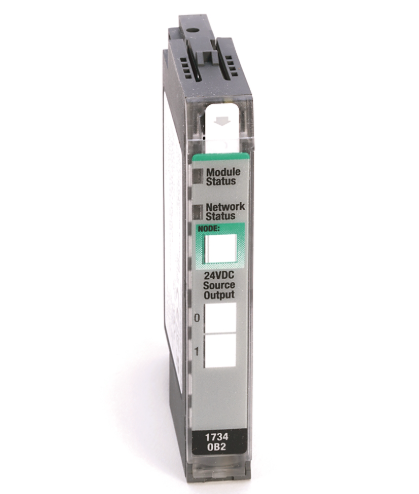
The listed 1734-OB8E is an Allen-Bradley POINT I/O 8-Point Digital Output Module with 24V DC NPN (sink) transistor outputs, and the critical differentiator: the “E” suffix = Enhanced Diagnostic / Electronic Protection — each of the 8 outputs has per-point electronic fusing (programmable 0.1–0.5 A trip), open-wire detection, and overload/short/load-missing diagnostics that surface directly into Logix controller tags (no guessing which point blew — the fault bit tells you). This makes OB8E the preferred choice over the base 1734-OB8 (which has basic protection but no per-point diagnostic granularity or electronic fusing).
POINT I/O is Rockwell’s distributed, compact I/O platform — modules are ~12.7 mm thin, snap onto a POIN bus behind the Adapter head module. The architecture: Adapter (AENT/AENTR) + POINT bus + I/O modules (right-expanding) + terminal base (1734-TB / 1734-TBS) per module. Each I/O module MUST have a matching Terminal Base (TB) — the module snaps onto TB, and field wiring goes to the TB screw terminals. Two TB types: 1734-TB (standard) and 1734-TBS (spring clamp) — “S” = spring.
- 1734-OB8E (main) → 8 × 24V DC NPN sink transistor, 0.5 A/pt, 4 A max/module, per-point electronic fuse (re-armable via tag write — no physical fuse to replace!), open-wire detect, overload/short diag → Logix tag. Needs 1734-TB or -TBS terminal base.
- 1734-OB4 → 4 × 24V DC NPN sink, 0.5 A/pt, 2 A max/module — smaller point count, basic protection (no E-enhanced diags). Cheaper than OB8E.
- 1734-OB4E → 4 × 24V DC NPN sink, 0.5 A/pt, 2 A/module — E = enhanced per-point electronic fuse + diags (same E-feature as OB8E but 4-pt). Useful when you need diags but only 4 outputs.
- 1734-232ASC → POINT I/O ASCII Serial Module (RS-232) — free-port ASCII communication to 3rd-party devices: barcode scanners, weigh scales, printers, vision cameras. Configured via Studio 5000 ASCII instruction set; maps to Logix strings/tags. One RS-232 port (DB9 or terminal block depending on TB).
- 1734-485ASC → Same as 232ASC but RS-485/422 (half/full duplex) — longer distance, multi-drop (32 nodes), typical for Modbus RTU to drives, power meters, flow computers.
- 1734-4IOLK → POINT I/O IO-Link Master Module, 4 ports (K = conformal coat). Each port supports 1× IO-Link device (sensor/valve with IO-Link) OR can run SIO mode (standard 24V DC DI/DO via IO-Link hub like 1734-IE8C/1734-OE8C — up to 8 devices/hub). Integrates IO-Link device params (VDM/VDO) into Logix tags — no extra gateway.
- 1734-AENT → POINT I/O EtherNet/IP Adapter (head module) — the “brain” of a POINT rack: connects POINT bus to EtherNet/IP network (Logix + HMI + SCADA). 10/100 Mbps, supports Device Level Ring (DLR) for ring topology (AENTR does DLR; base AENT does NOT — AENT = linear star only). AENT supports up to 8 POINT modules (including itself? Actually AENT = 8-module capacity incl adapter? No — AENT: adapter + up to 8 I/O modules = 9 total slots? Wait POINT: Adapter occupies logical slot 0, then up to 8 I/O modules (total 9 positions on bus but physically AENT + 8 modules = 9 modules wide). AENTR = up to 16 I/O modules + DLR ring. Key: AENT is mandatory — without it, 1734-OB8E etc. can’t talk to Logix.
- 1743-8CFG → ⚠️ Likely a typo in your list — “1743” prefix doesn’t belong to POINT I/O (1734) or SLC (1747). Possibly you meant 1734-ACNR (Adapter, conformal, DLR) or 1734-8CFG (if such exists — not in standard catalog; might be a custom/obsolete config module?). Or 1747-SN? I’ll treat as “verify p/n” in notes — if you meant 1734-AENTR (the DLR-capable adapter, conformal optional) or 1746-? (SLC 500 rack) — please confirm. I’ll footnote it in the variant table.
💡 POINT I/O Value Prop: Instead of running 50 wires from a remote station back to main panel, you put an 1734-AENT + POINT modules locally at the machine/valve-bank, run one Ethernet cable (Cat5e/6) back to the Logix rack — saves wire, simplifies troubleshooting, diagnostics (OB8E open-wire = tells you exactly which field wire is loose in the Logix tag without going to site).
Key Features (1734-OB8E)
- Outputs: 8 × 24V DC NPN (sink) transistor — 0.5 A/pt, 4 A/module max
- Enhanced “E” Diagnostics: Per-point electronic fuse (programmable trip 0.1–0.5 A), re-armable via Logix tag write (no fuse to pull), Open-Wire Detect, Overload/Short/Load-Missing → individual fault bits in controller tag
- Terminal Base Required: 1734-TB (screw) or 1734-TBS (spring) — module snaps onto TB, field wires to TB
- POIN Bus: Thin 12.7 mm/module — up to 8 modules (AENT) or 16 (AENTR) per adapter
- Backplane Current: 5V @ ~60 mA (from POINT bus — AENT supplies bus power)
- Country of Origin: USA (Rockwell Automation / Allen-Bradley)
Model & Variant Reference (Your 1734 List + AENT)
Model | Type | Key Spec | Best For |
|---|---|---|---|
1734-OB8E (main) | 8-pt 24V DC NPN Out, Enhanced | 0.5A/pt, 4A mod, per-pt eFuse + open-wire diag | Distributed valve banks, SSR drive, where you want wire-break diag in Logix |
1734-OB4 | 4-pt 24V DC NPN Out, Standard | 0.5A/pt, 2A mod, basic protection | Cost-sensitive, only 4 outputs needed, diag not critical |
1734-OB4E | 4-pt 24V DC NPN Out, Enhanced | 0.5A/pt, 2A mod, per-pt eFuse + diag | 4 outputs but need diags (e.g., critical safety-related loads, not SIL but diagnostically important) |
1734-232ASC | ASCII Serial (RS-232) | Free-port ASCII → barcode/scales/vision | Tying non-EtherNet 3rd-party devices into Logix via POINT |
1734-485ASC | ASCII Serial (RS-485/422) | Modbus RTU / ASCII multi-drop | Drives, power meters, flow comp — longer distance than 232 |
1734-4IOLK | IO-Link Master, 4 port (K=conformal) | 4× IO-Link devices (or SIO hub 8pt each) | Smart sensors/valves (Balluff/IFM/Sick IO-Link) — params in Logix |
1734-AENT | POINT I/O EtherNet/IP Adapter (head) | 10/100, up to 8 I/O modules, no DLR | Base adapter — linear/star topology to Logix |
1734-AENTR | POINT I/O Adapter, DLR-capable | 10/100, up to 16 I/O modules, DLR ring | Ring topology (DLR) for higher avail — if you need >8 modules or ring |
1743-8CFG | ⚠️ Pls verify p/n — “1743” not a POINT (1734) nor SLC (1747) std prefix. Possibly 1734-ACNR / 1734-AENTR / 1746-? — confirm | — | — |
⚠️ Critical Notes:
Technical Specifications (1734-OB8E — 8-pt 24V DC NPN Sink, Enhanced Diags)
Parameter | Specification |
|---|---|
Model / Order Code | 1734-OB8E (Allen-Bradley POINT I/O 8-pt Digital Output, Enhanced) |
Series | POINT I/O (1734) — distributes on EtherNet/IP via 1734-AENT |
Outputs | 8 × 24V DC NPN (sink) transistor |
Rated Current | 0.5 A/pt; 4 A max/module; 2 A max per 2-pt group (typically group COM: OUT0-1 share COM0, OUT2-3 COM1, OUT4-5 COM2, OUT6-7 COM3 — 4 group COMs on TB) |
Voltage Range | 20.4 – 28.8 V DC (nominal 24V DC) |
ON-State Voltage Drop | ≤ 0.5 V @ 0.5 A (typical) |
OFF-State Leakage | ≤ 0.5 mA |
Enhanced “E” Features | Per-point electronic fuse (programmable 0.1–0.5 A trip), re-armable via Logix tag; Open-Wire Detect; Overload/Short/LoadMissing diag → per-point fault bits in controller tag |
Terminal Base (Req.) | 1734-TB (screw) or 1734-TBS (spring) — field wires here; module snaps onto TB |
POIN Bus Current (5V) | ~ 60 mA (drawn from AENT/AENTR) |
Indicators (LED) | Module status (SF/OK), Network (NR/NS), per-point Output (I/O) LED on module face |
Dimensions (W×H×D) | 12.7 mm(W) × 110 mm(H) × 76 mm(D) — thin POINT profile |
Weight | ~ 0.03 kg (module only); ~0.06 kg with TB |
Operating Temp. | -20 … +55 °C (IEC 60068-2 — some sources say -25 start); with K conformal = -40…+70°C |
Standards | CE, UL, cUL, C-Tick, KC, FM Cl I Div 2, RoHS |
Config Software | Studio 5000 / RSLogix 5000 — module properties → electronic fuse current limit set per point |
Country of Origin | USA (Rockwell Automation) |
Warranty & After-Sales
- Factory new units: 12 months warranty
- Refurbished units: 3-6 months warranty (bench: force ON each pt → measure V drop; simulate short → verify eFuse trip + Logix fault bit)
- Technical support for:
- POINT rack composition (AENT + TB choice + I/O modules count — AENT max 8 I/O, AENTR max 16)
- Terminal Base selection (1734-TB screw vs TBS spring — match field wiring preference)
- OB8E eFuse programming (Studio 5000 → module properties → set per-point trip 0.1/0.2/0.5 A → re-arm tag method)
- NPN wiring confirmation (load between +24V and Y□; COMx → 0V; confirm field device is NPN-expecting — if PNP needed consider 1734-OB8EP)
- 1734-232ASC/485ASC ASCII config (baud/parity/stop bits, ASCII instruction in Logix — tie barcode scanner/scale)
- 1734-4IOLK IO-Link setup (port config → IO-Link device DD file → VDM/VDO mapping via AOI)
- AENT vs AENTR choice (DLR ring need? >8 modules need AENTR)
- Optional: 1734-AENT/AENTR adapter, 1734-TB/TBS terminal bases, 1734-IB8 (input companion), 1734-IE8C (IO-Link hub 8DI), 1734-OE8C (IO-Link hub 8DO), Studio 5000 license
Delivery Time
- Standard delivery: 3-5 working days (stock NOS)
- Express shipping available upon request
Why Choose Our Store
- Genuine Allen-Bradley POINT I/O — not gray-market (eFuse calibration & POINT bus PHY critical)
- Global supply network with competitive pricing on 1734 distributed I/O
- Expertise in POINT I/O system composition (AENT selection, TB choice, OB8E eFuse diag, ASC serial, 4IOLK IO-Link)
- Comprehensive technical documentation (POINT bus slot map, OB8E TB terminal layout, eFuse re-arm tag screenshot, ASC ASCII wiring, 4IOLK IO-Link VDM mapping)
- Responsive customer service and support
Applications
- Distributed Valve Banks / Cylinder Manifolds: Put AENT + OB8E + IB8 (input) locally at valve bank → one Ethernet cable back to panel — saves 50+ wires. OB8E eFuse trips → Logix tells you which solenoid shorted, re-arm after fix.
- Packaging Machine Distributed I/O: POINT thin profile fits in small enclosures on machine segments (feeder, wrapper, case packer) — each segment gets its own AENT or daisy-chain DLR (AENTR) around machine.
- Barcode / Weigh Scale Integration: 1734-232ASC → connect barcode scanner / checkweigher directly into Logix tags via ASCII inst — no separate serial gateway PC.
- IO-Link Smart Sensors: 1734-4IOLK + IFM/Balluff/Sick IO-Link sensors (pressure, flow, vibration) → device params (min/max, thresholds) in Logix via VDM — no extra IO-Link master gateway.
- Retrofit SLC 500 Rack I/O: Replace remote SLC rack (1746 I/O) with 1734-AENT + POINT modules — keep EtherNet to Logix, gain diagnostics (OB8E open-wire) SLC couldn’t do.
评价
目前还没有评价